
by Michael Bennett and Denzel Glover
Editor’s Note: This is part of our series exploring the juvenile justice landscape in Pittsburgh with a focus on education and mental health. These stories were funded by Staunton Farm Foundation and The Grable Foundation. You can read other essays from inside of the juvenile justice system here and here.
Over 20 juveniles are incarcerated at the Allegheny County Jail under Pennsylvania’s Act 33, a law which mandates that children as young as age 14 are charged as adults for certain crimes considered to be serious by lawmakers. Read our investigation into ACT 33 cases and juveniles at the Allegheny County Jail here.
Many incarcerated people report that being unable to help and lend emotional support to friends and family contributed to feelings of deep isolation. This disconnection from community is one of the most difficult aspects of life for them.
The following are correspondence between Michael Bennett and Denzel Glover, a young man who is incarcerated. Bennett and Glover met when Bennett was teaching creative writing in the Allegheny County Jail. Glover was a juvenile at the time, housed at the ACJ. They have maintained correspondence now that Glover is an adult and is housed in a Pennsylvania State Correctional Institution.
This is the first of three installments of the correspondence between Bennett and Glover.
Part 1
09/27/23
Dear Denzel,
It’s been five years since the last time we spoke. We were at the reading in the visitation room, in November of 2018, the week of your 18th birthday. Do you remember that space? Its low ceilings, and cinderblock walls painted cherry red? We set up rows of chairs and gave out chips and cookies and bottles of pop while everyone shared their writing and clapped for each other. The adults wore red jumpsuits, the same color as the walls, and the juveniles were in khaki gray, with those bright orange plastic sandals. This was one of the few occasions they let juveniles and adults in the same room, though you had to sit in separate sections, a foot of space down the aisle to mark an invisible boundary that seemed pointless; it was a line that had already been breached.
But you had just turned 18, so you were in red. How strange it was to see you in this color, to acknowledge that you were an adult in the eyes of the law. You had been treated like an adult for some time, after all. You were only sixteen when they arrested you. Sixteen, and there was your face, your name, your neighborhood on the 11 o’clock news: “Boy, 16, charged as adult in shooting …” You were young enough to be called a boy, but that did not stop them from carting you down to the jail. You, in the back of a police van in handcuffs, your weight shifting as the van rolled down second avenue, under the bellies of the bridges dripping into the damp streets, the sting of metal on your wrists as the van turned down the steep hill and waited for the intake gates to open. You, wondering how many nights might pass until you saw your mother’s face again.
I never asked you about your case because we weren’t supposed to, and because I didn’t want to know—didn’t want to believe that you would try to shoot someone, another boy no older than you. Some part of me still does not believe it, and some part of me knows these things are more complicated than anyone could explain on the news, or in a court room, or to anyone who doesn’t check behind their shoulder every ten steps, anyone who doesn’t fear for their life every time a strange car passes in the street.
You were defending yourself. You were safeguarding your body, your sanity, your humanity from a world that never aimed to protect you. You had lost your best friend when you were fifteen. You were too young to be facing all that violence, that grief. But that didn’t make it any less real. And nothing could erase the fact that you spent the last days of your youth at the county jail, with your inmate number and mugshot taped to your wrist, doing your homework in a dark cell with a half-cut pencil.
Over a year later, and here was the second birthday you would spend at ACJ, days that should always be meant for celebrations, but in there, they were always sour. Perhaps this one was the sourest of all, the milestone of your adulthood, in a space where you were so clearly marked by your age, in color and name. You were moved from pod 1-C, and handed red scrubs, and you were no longer a “juvenile.”
I have been using this term because I don’t know what other word to say. Teenager? Adolescent? Child? You were all of these things and none of them. The term “juvenile,” by definition, means youth. Here was a group of “juveniles” who, because of the severity of their accused crimes, were being held at an adult jail, charged and tried as adults. Here was a group of children who had lost the right to be called such. Here was a contraction, a paradox. The word “juvenile,” without context, and especially in the plural, implies a collective guilt. But none of you had been convicted. You were waiting for trial, and so you were, by law, still innocent. The guilt was not yours, but ours. Your time in the county jail was a societal guilt, a failure of community, of city, of country.
Do you remember the day when your childhood ended? Was it one moment, or a sequence, a slow splintering of your youth? Do you mourn the childhood you lost, the time that was taken from you?
It’s strange to say that if you hadn’t been charged as an adult, I would never have met you. I wouldn’t be writing to you now. You were my favorite student. Every Monday you came to class clutching your notebook at your arm, ready to share something you had written over the week. You were the student who everyone else respected. You motivated the other kids to read and write and listen to each other. It’s because of you that they took the class seriously, and that we could make as much progress as we did, in those few days when class wasn’t cut short with lockdowns, or whatever else was going on at the jail.
I still have some of the poems you wrote. The one I have in front of me is now is, “Had A Dream:”

I can’t remember if you shared this poem on the day that John Edgar Wideman came to visit. We were unsure if they would let you down because you had moved into a different pod. At the last minute you arrived in time to speak with Wideman, and hear him share his own stories about writing, and growing up in Pittsburgh. We had read some excerpts of his book Brothers and Keepers, and I kept promising that I would bring in full copies of the book for everyone. But there were all kinds of restrictions about what kinds of books we could bring into the jail, and we had accidentally ordered hard-cover copies, so they didn’t make it in time for his visit.
It was only a few weeks after Wideman came that Kristine wrote to me, informing me that you had been released with time served. She said that you had stayed long enough to attend graduation, where she got to meet your mother and stepdad. She said they were so proud of what you had accomplished, especially after everything you’d been through. She said that she was relieved that you were finally getting out, but she was also worried about the trouble you might face on the streets.
I still owed you a book. I sent a copy to your address. I wrote something short to you, thanking you for all of your writing, and wishing you luck in your future. I felt like I was being sneaky, sending you the book. There were some legal stipulations, and I wasn’t technically allowed to contact you while you were still on parole, but I didn’t care. Did you ever get it?
A few weeks later, I saw you at a bus stop. I was driving to the grocery store, and you were at the bottom of the hill, at the corner of Baytree and Evergreen, just before it climbs up under the highway and down to McKnight. You were standing there, bobbing your head, singing along to music in your headphones. I thought about stopping to offer you a ride, but I hesitated, I kept driving. I worried about intruding on your life, crossing that strange boundary that always lingers when I run into students outside of school, a chasm where we meet outside of our roles, and my authority dissipates. That strangeness is only multiplied when that school is inside of a jail, when you are only in the room because you are physically confined in it. But it was still a joy to see you waiting at a bus stop, to see you free to go wherever you pleased.
Not long into the next year I heard you were back at ACJ on another charge. When Kristine told me, my stomach turned. I had been so sure that you would never be back. Kristine said you were going to trade school, that you had plans to become a carpenter. And maybe you were on the right track, and something went wrong. Maybe you caught a bad break, and got pulled over for something stupid. Maybe you were in the wrong place at the wrong time. Maybe I should stop speaking in cliches. Maybe it’s all too difficult for anyone to explain.
I’m finding it hard to acknowledge that you’ll be reading this letter in prison. I can’t imagine what it must have been like to spend the last few years in a cell, when the whole system was on a lockdown, and no one could visit you. I stopped visiting the jail during the pandemic and I haven’t gone back since. Kristine retired last year, and I don’t know who to contact inside. But I miss teaching there. I miss the experiences I had, and the relationships I built with students like you, and Kristian, and Kenny. Remember them? Is there anyone at Chester that you knew from our class?
I spent a year teaching a class of adults at SCI Western before it closed, and one thing that amazed me was how connected all of the men were to their communities, even from the inside. I hope you have found some sense of community inside like you had on 1C. I hope you have made friendships and discovered hobbies. I hope that you are still able to speak with your family and friends. Your mother, and your son—how old is he now?
I hope you are thinking positively about the future, for the time you still have to make the most of your life. One thing about going to prison so young is that you will still be very young when you get out.
My friend recently told me about a study from Stanford about juvenile recidivism. She said that students in juvenile detention who wrote a one-page letter to a former teacher had drastically lower rates of re-offense. When they wrote letters telling their side of the story, stating their
dreams and goals and values, they built real relationships with those teachers, and found new support in their school system. I know you are no longer a student, but I still believe in this process, this idea of building relationships. So I am, in part, writing this letter to reconnect, in hopes that you might reply, in whatever way you see fit. And in that reply, your chances of getting out of this system forever could multiply. I am sending energy and strength and solidarity to you from the outside, like a rope that might slowly pull you out. I know it is not that simple, but I can try.
I would love to hear from you. What books are you reading? If you never got Brothers and Keepers, I’ll send you a copy. Are you still writing? I would love to read anything you’re willing to share. What is your favorite way to pass the time inside? What other hobbies have you discovered? What do you dream of doing, on the first day you’re free again?
Much Love and Solidarity,
Mr. Mike
10/5/23
Hey Mr. Mike,
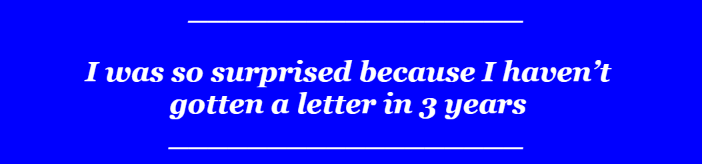
It’s been a while since I spoke to you. I appreciate you reaching out to me, this means a lot. When the C.O. said I had a letter I was so surprised because I haven’t gotten a letter in 3 years.
To update you on what’s going on with me, I’m upstate as you can see for another shooting. They gave me 4-8 years but before I got charged with this case I originally was arrested on 2 guns which the feds picked up. I went from the ACJ to Indiana County Jail because the feds don’t have a federal contract. I was up there from Nov. 2018 when I was arrested to Aug. 2019 but was kicked out for fighting because a lot of older dudes tried to disrespect me because I was young and I wasn’t with that because in jail all you have is respect. You lose that and now you’re dealing with more problems.
I went to Youngstown Ohio from Aug. 2019 to Oct. 2020 and I got into a few fights up there because in the feds it’s real geographical like you have to stick with your city because you’re in jail with people all over the U.S. I had some situations that led to fights and doing a lot of the hole time. If you didn’t know the hole is the restricted housing unit, you get no commissary, only 3 meals a day, 3 showers a week, and you’re in your cell 23 hours a day with nothing to do but stare at the walls or read books. Altogether I did around 220 days in the hole out of my five years I’ve been in jail and if you’re not strong enough he hole can make you go crazy because you also can’t use the phone to contact your loved ones. It’s letters only.
Doing a lot of hole time, I took that time to figure my life out. I asked myself: “how did I end up in the feds at 19 years old looking at 10-20 years upstate and 8 years in the feds?” I came up with a master plan on what I want in life. I want to give my son the opportunity I didn’t have. I was raised in Northview Heights, one of the worst hoods in Pittsburgh. My mom did her best to raise me but to see her struggle me killed me inside.
Then me having my son at 14, I wasn’t even old enough to get a summer job, so what choice did I have? I did what was around me and I got in the streets, which helped me afford diapers, wipes, clothes, shoes, school supplies for me and my little sister. Because my mom couldn’t afford it. Then I lost my big cousin who was like my mentor to the streets. He was killed and I was guilty by association and it led to these shooting cases.
But back to what’s going on now. The feds gave me 6 and a half years and I was taken back to the ACJ to handle my current shooting case. They offered 10-20 years, I denied it, then it was 7-14 years, denied it, then it was 4-8 years and at the time I was in jail 3 years so I took it thinking they were going to run my time with the feds, which they didn’t. They only counted the 3 years for the state. The feds only counted 20 months out of my 3 years so now I’m upstate and I have 5 years on my 4-8 years but when I seen parole last November 2022 they denied me because I got into a fight, so now I see them next month and hopefully I get paroled because the feds is not counting none of my time. When I leave the state I still have 58 months to do which is basically 5 years. If I do make parole this time I’ll end up doing 9 years and 10 months which is a long time.
Being in the streets only took years and people I love out my life. I lost 9 people I grew up with this trip. Lost my uncle and friend to overdoses. Lost my boy Eugene to gun violence back in Jan 2023. Dudes I knew as kids — Tay, Nas, jar, Jam, Jy — lost them to gun violence. I want to be done with the streets because I refuse to have my mom bury me. I can’t change my past so I can’t come home trying to drop old beef but I can try to not put myself in them situations. To answer your question about when I think I lost my childhood it was when life threw me some cards that I was forced.
I feel like when I was released the last time in 2017 I lacked the resources to help get me my own house or car or job. It’s like it’s designed for us to go back to what we been doing. If I still live in the same environment, how can I change if my environment don’t let me? So my goals this trip when I get home are: get a job, car, apartment, start a cleaning company, and promote my music to talk about my pain.
My message to anybody in the streets reading this: if you got an option leave them streets alone. It’s no love in them. I’m not the preaching type but you’re guaranteed death or jail and this jail stuff is corny. In a little cell with another man, same place you use the bathroom is where you get water to drink. Family, kids, girlfriends, living life while you stuck. Them boys you was out thuggin with be the same ones to leave you. Commissary aint cheap. Three trays a day and the food is disgusting and with the next thing in the streets is death, well aint no coming back from that. Find something in life you love and strive for it. Don’t make no career in them streets because it don’t last long. Them boys in college and working is really winning. They got all the money, the girls, and the main thing: their freedom.
But yeah, Mr. Mike, I been reading a lot of self help books so send it when you can. Stay in contact with me and you keep carrying it how you do Mr. Mike.
Thank you!
Denzel
Michael Bennett (he/him) is a writer and educator from Pittsburgh, Pennsylvania. He holds an MFA in Creative Nonfiction from Chatham University. He teaches young writers at Pittsburgh’s Creative and Performing Arts High School, and facilitates workshops with incarcerated writers at the Allegheny County Jail through Write Pittsburgh. Michael’s work has appeared in The Normal School, JMWW, Sport Literate, and elsewhere.